
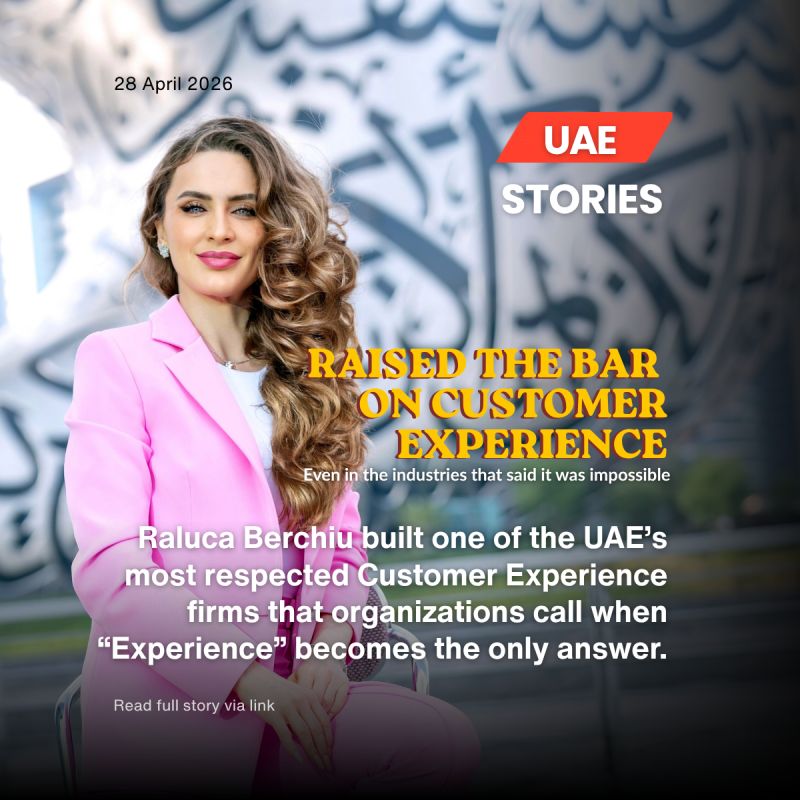
She Built CXM Into One Of The UAE's Most Respected Customer Experience Firms That Organizations Call When Experience Becomes The Only Answer.
Raluca Berchiu raised the bar on Customer Experience, even in industries that once believed it was impossible. She built CXM into one of the UAE's most respected customer experience firms, trusted by organizations when experience becomes the only answer.
What Happens When Good Enough Becomes The Standard Nobody Questions?
Somewhere in your organization right now, a customer is deciding to leave. They will not tell you. They will not file a complaint, respond to a survey, or schedule an exit call. They will simply be gone.
This is the natural result of an experience that was never truly designed around them.
Raluca Berchiu recognized this pattern early in her career across legal and commercial environments. She learned that the most important truth about any organization is rarely visible from the inside.
Instead of looking at processes internally, she trained herself to start from the outside. She began with the person receiving a decision, a service, or a process, and worked backward to identify the gap between what organizations believe they deliver and what people actually experience.
She took this approach into industries where customer experience was never considered important, including maritime, satellite operations, telecommunications infrastructure, and wholesale supply chains. In each of these sectors, she did not just identify the gap. She closed it.
In industries where experience was never part of strategy discussions, she made it a standard that organizations still follow today.
Why Do Customers Leave Without Saying Anything?
According to Berchiu, by the time problems appear in business metrics, customers have already made their decision to leave.
They make this decision in small, unnoticed moments that organizations often ignore.
When customers feel friction, confusion, or lack of clarity, they rarely complain. Instead, they quietly disengage.
What businesses see later is only the effect. Declining retention, rising acquisition costs, and a growing gap between loyal customers and those who are simply waiting to leave.
This insight shaped Berchiu's work when she moved to Dubai in her early twenties. Over time, she built a strong body of work across industries such as healthcare, aviation, banking, hospitality, government, and complex B2B sectors.
Through CXM, the firm she founded, she became the person organizations turn to when they are ready to treat customer experience as a driver of performance, not just a reflection of it.
What Is The Hidden Revenue Problem Every CEO Should Understand?
Every organization loses customers. The real issue is when they lose them without knowing why.
This creates a structural blind spot that grows over time.
Customers who are dissatisfied usually leave silently. Businesses do not see complaints. Instead, they notice indirect signals such as lower retention rates, increased marketing costs, and weaker customer loyalty.
Berchiu describes this as the leaky bucket problem.
Revenue is slowly leaking out through gaps that are not visible internally. Each department may appear to perform well on its own, but the combined experience delivered to the customer tells a different story.
Customers do not interact with departments. They experience the organization as a whole.
Even when individual teams show improvement, the overall experience may still fail.
This is why the problem often goes unnoticed until it starts affecting financial performance.
For Berchiu and CXM, this is where every engagement begins. Customer experience is not just about satisfaction. It is a revenue and growth issue that requires deep organizational change.
What Does Fifteen Years In The UAE Teach About Standards?
Berchiu's background includes law, international relations, and business administration. These disciplines helped her understand complex systems from multiple perspectives.
In the UAE, she applied this thinking to industries that were often overlooked when it came to customer experience.
What she discovered was consistent across sectors.
Customer experience does not disappear when ignored. It simply becomes invisible to the organization while remaining very real for customers.
Over the past fifteen years, the UAE has become a unique environment for high service standards. From seamless airport systems to efficient government services and world class hospitality, the country has set a high benchmark for how people are served.
This environment shaped Berchiu's perspective.
She observed that people do not separate their experiences by industry. A smooth experience in one area becomes an expectation in all others.
For example, a patient visiting a hospital already understands what a smooth and well guided experience feels like because of their interactions in travel, retail, or digital platforms.
These expectations carry forward into every new interaction.
Standards evolve whether organizations are ready or not.
What Are The Two Stages Of Customer Experience Most Organizations Miss?
The work led by CXM is based on a simple but powerful idea. There are two stages of customer experience transformation, but most organizations only complete one.
The first stage focuses on fixing what is broken.
This includes mapping customer journeys, identifying friction points, and improving processes across teams and systems. This stage alone often reveals major issues that directly impact revenue.
CXM treats this as a performance intervention because it produces measurable business results.
The second stage is where true differentiation begins.
Once the experience is functional, the focus shifts to designing what Berchiu calls Signature Experiences.
These are intentional, carefully designed moments that define how customers feel when interacting with a brand. They go beyond efficiency and create a unique identity.
Instead of asking how to improve service, organizations begin asking what an experience designed specifically for their customers should feel like.
This is where long term competitive advantage is created.
How Has This Approach Impacted Different Industries?
Berchiu's work has transformed customer experience across multiple sectors.
In healthcare, it has introduced hospitality level care into patient journeys, improving how patients experience treatment from the moment they arrive.
In aviation, it has improved high pressure moments such as check in and boarding, making travel more calm and structured.
In banking, it has influenced decision making and governance, ensuring that customers experience clarity and consistency.
In government services, it has simplified complex processes, reducing time and effort for citizens.
Despite the differences between these industries, the core principle remains the same.
Excellence is the standard, and experience is the evidence.
Why Is There A Gap Between Knowing And Doing?
Most organizations understand that customer experience matters. They invest in it, measure it, and talk about it at leadership levels.
However, there is often a gap between what they believe they deliver and what customers actually experience.
This gap is created by small misalignments.
Processes may be designed for internal efficiency rather than customer ease. Incentives may prioritize speed over quality. Technology may work well in isolation but fail when integrated across teams.
These issues build over time.
Closing this gap requires honesty and alignment across the entire organization. It cannot be limited to one department.
According to Berchiu, delivering consistent experience is not a CX initiative. It is a leadership decision.
What Is Already At Stake For Businesses Today?
Customer expectations are rising across all industries.
People compare every interaction to the best experience they have ever had, regardless of where it came from.
Organizations that succeed are those that make customer experience part of how they operate, not something added on later.
For companies that have invested in customer experience but are not seeing clear results, the issue is usually not effort.
It is the level at which they are working.
Improving individual interactions leads to better interaction scores. But real business impact comes from improving the system that creates those interactions.
This is where retention improves, growth costs decrease, and brand value strengthens.
What Defines Success In Customer Experience Today?
According to Berchiu, success is no longer about excelling in one moment.
It is about being consistent, clear, and thoughtful across every interaction over time.
Organizations that understand this are moving ahead.
Those that are still deciding are falling behind.
The gap between them continues to grow.
Final Perspective
Across fifteen years and multiple industries, Raluca Berchiu has proven that customer experience is not limited by sector or complexity.
Her work shows that even in environments where change seems impossible, meaningful transformation is achievable.
Through CXM, she continues to help organizations fix hidden gaps, design meaningful experiences, and build systems that sustain long term performance.
Her journey reflects a simple but powerful truth.
Customer experience is not just how a business feels to its customers. It is how a business performs.