
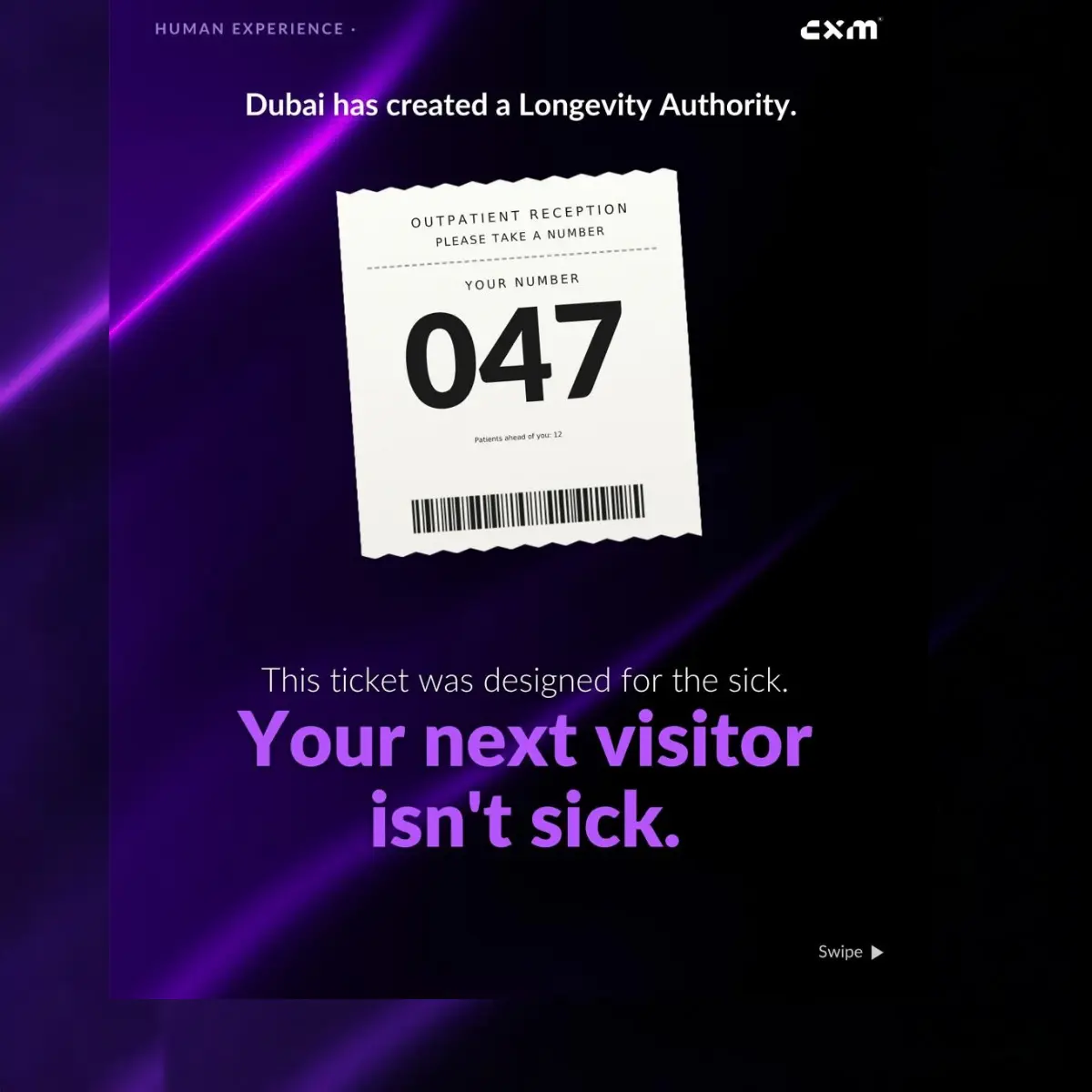
A healthy, informed visitor is heading for Dubai's hospitals, and human experience in healthcare will be tested across the whole visit, from booking to the decision to return.
At most outpatient receptions, visitors take a number and wait in an area arranged for people who feel unwell. The ticket is the most visible part of a visit that usually began days earlier, with a phone queue, a form about symptoms and an insurance check. The sequence has served hospitals for decades, largely because the people moving through it expected little else.
The Dubai Longevity Authority is about to test that expectation. Created under Law No. 17 of 2026, the authority saw its strategy approved in September by Sheikh Hamdan bin Mohammed, Crown Prince of Dubai, with a goal of adding more than Dh35 billion to the economy over the next decade. Its chairman also leads Dubai's Department of Economy and Tourism, which says a good deal about the visitor the emirate has in mind: healthy, informed, often flying in, and coming to stay well.
Raluca Berchiu, founder and CEO of CXM, has worked inside hospitals, hotels and airlines across the region and reads the news from the visitor's side. "In hotels, a wait is designed," she says.
"In most hospitals, a wait is simply endured. A sick person might accept that. A healthy person paying for prevention rarely will."
What does a healthy visitor reveal about the hospital patient journey?
Hospitals have spent years improving patient experience, with friendlier call centers, warmer greetings and shorter queues, mostly within one assumption: that the person arriving has something wrong with them. The assumption is seldom written down, because it lives in the operating model and runs from the first call to the follow-up.
Booking starts with a symptom, a referral or an insurance approval. Registration opens with what brings the person in, waiting areas are sized for throughput, and the next contact usually waits until something goes wrong again. Together, these choices describe a visit built to receive a problem.
Hospital leaders tend to recognize the pattern and quietly manage around it, often with a separate entrance or a VIP floor. Berchiu names it more directly, describing the longevity visitor as the person for whom the assumption fails most visibly, and Dubai's strategy suggests many more of them are on their way.
Why do lounges and VIP floors leave the gap open?
Providers who have noticed the shift usually borrow the look of hospitality, with a lounge and a concierge desk. In many cases the appointment line still follows a clinical script, the registration form still asks about symptoms, and a nurse still calls the next number from a list, which leaves the lounge as the one part of the visit planned with a healthy guest in mind.
The deeper difficulty sits in how experience is judged. Most patient experience scores are built around an episode of care, where the clinical outcome carries much of the weight and a patient who leaves recovered will often forgive a long wait.
A visitor who comes for prevention has no illness to resolve and no recovery to measure, so the booking, the welcome, the wait and the way they were spoken to become most of what they take home. Many will compare every moment of the visit with a hotel they checked out of that morning.
What is human experience in healthcare?
In Berchiu's framing, human experience in healthcare keeps patient experience essential and extends the design to the whole person across prevention, care and recovery, bringing the journeys, employees, processes and technology around that person into one model. "Before a person becomes a patient, they are a human being," she wrote after the Forbes Healthcare Summit in September.
In that model, booking works more like a reservation, with a confirmation that answers questions before they are asked. The welcome is designed for someone who may have nothing wrong, waiting time is planned and used, and information travels ahead of the visitor, so nobody repeats a history already submitted online. The relationship is built to last for years, which is the timescale of longevity care.
Employee experience sits at the center, since a journey redesigned without the people who deliver it tends to drift back to old routines within months, which is why CXM pairs patient and employee experience in one program.
What do high-performing hospitals do differently?
Hospitals preparing well for this visitor begin by looking at the whole visit the way a healthy person would. Berchiu puts four questions to their teams:
- Does booking feel effortless, or like admin?
- Does your welcome assume something is wrong?
- Would a healthy person feel like a guest or a case?
- Would they choose you again next year?
The answers rarely sit with one department, since the contact center, digital teams, reception, nursing, facilities and outsourced services each own part of the experience, which is partly why the questions are seldom asked together.
At CXM, the work starts with a patient experience assessment that walks the journey first-hand, through hospital mystery shopping by phone, online and on site. Patient journey mapping then follows that visitor from the first online inquiry to the follow-up a year later, and patient experience training prepares contact center, front-of-house and clinical teams to receive someone who arrives well. For international visitors, that journey begins at the airport.
What should it feel like to arrive healthy?
This season, CXM is bringing these questions into keynotes, leadership offsites, patient experience workshops and healthcare conferences. For providers preparing for Dubai's longevity economy, the conversation continues into patient experience consulting, medical tourism consulting, executive advisory and transformation work, drawing on the firm's experience across healthcare, hospitality and aviation in the UAE, Saudi Arabia and Europe.
If the next person to book an appointment at your hospital is healthy, which of the four questions would your leadership team find hardest to answer?